Legally Reviewed by Matthew Dolman
All content published on FileAbuseLawsuit.com is reviewed for legal accuracy by Attorney Matthew Dolman, who is a nationally recognized trial attorney and founding partner of Dolman Law Group. Matt has built his career litigating complex, high-stakes injury, mass tort, and sexual abuse cases. He has a reputation for being one of the best trial attorneys in the country and a skilled and fearless advocate for sexual abuse survivors.
Matt Dolman is a trauma-informed attorney, meaning he has completed formal trauma training and applies those principles through survivor-sensitive case protocols, advocacy partnerships, and courtroom strategies designed to minimize retraumatization.
Matt has handled thousands of sexual abuse cases and has fought, and continues to fight, some of the biggest corporations, institutions, and even government agencies, to get justice for abuse survivors.
For too long, juvenile detention centers across California have failed to protect the youth in their care, allowing unacceptable abuse to happen. Survivors like you have suffered deeply because of these systemic failures.
But that suffering does not have to define your future. You have the power to pursue justice, demand accountability, and take the first steps toward healing. Filing a California juvenile detention center sexual abuse lawsuit isn't just about financial compensation; it's about standing up and saying what happened to you was wrong.
It's about ensuring those responsible are held accountable. Most importantly, it's about giving you the opportunity to reclaim your voice, your dignity, and your strength. We will stand shoulder to shoulder with you throughout this process. Sadly, there is systemic and widespread sexual abuse in juvenile detention facilities. Just this year alone, Los Angeles County agreed to pay over $4 billion to resolve thousands of sexual abuse claims.
This is a difficult and personal decision. When you are ready, the team at File Abuse Lawsuit is here to support you every step of the way. Together, we can work to ensure your story is heard, your rights are protected, and justice is served.
Trauma-Informed Team Focusing on Child Sexual Abuse
This is a difficult and personal decision. When you are ready, the team at File Abuse Lawsuit (a division of Dolman Law Group) is here to support you every step of the way. Together, we can work to ensure your story is heard, your rights are protected, and justice is served.
Our team is trauma-informed and trained in representing the interests and needs of child sexual abuse survivors. We are deeply committed to trauma-informed advocacy and the need to avoid re-traumatizing our clients who were sexually abused.
Can I file a lawsuit for sexual abuse in a California juvenile detention center?
- California juvenile detention centers have faced growing scrutiny for decades of reported abuse and systemic neglect. Survivors are now filing lawsuits to hold institutions accountable and seek compensation.
- You can file a juvenile detention center lawsuit even if the abuse happened years ago thanks to California's extended statute of limitations.
- You may be entitled to compensation for medical care, therapy, emotional suffering, and lost opportunities.
- Lawsuits can help uncover institutional failures and prevent future abuse through reforms and accountability.
- Federal and state laws like PREA and CANRA exist to protect juveniles in custody, and violations of these laws strengthen your legal case.
- You won’t have to go to court unless you want to—many cases settle privately and your identity can be kept confidential.
- You pay nothing upfront, and legal fees are only owed if your case wins.
Why Choose File Abuse Lawsuit for Your California Juvenile Detention Sexual Abuse Lawsuit
When you’re deciding who to trust with something this personal, you need a team that brings more than just legal experience. You need people who care. People who listen. People who fight tirelessly to make sure you’re treated with dignity.
At File Abuse Lawsuit/Dolman Law Group, we’re proud to offer all of that, and more:
- 115+ Years of Combined Experience: Our attorneys have decades of experience handling sensitive personal injury and sexual abuse cases.
- Over $750 Million Recovered: We have helped thousands of clients get the justice and compensation they deserved.
- Trial-Ready Legal Representation: We don’t back down from a courtroom. If a trial is what it takes to get justice, we are fully prepared.
- Personal Support from Start to Finish: You will never be just another case. You’ll have access to your attorney and our managing partner from day one.
- A Deep Commitment to Survivors: We don't just handle cases—we care about people. We will connect you with counseling, support services, and resources for healing. Our legal team is comprised of former sex crime prosecutors, federal prosecutors, and trial lawyers with significant experience litigating civil sexual abuse claims.
We offer free, private consultations. We’ll never pressure you. And we only get paid attorney’s fees if we win money for you. That means you can focus on healing while we focus on justice.

Sexual Abuse Is Not Uncommon in Juvenile Detention Centers
Sexual abuse in juvenile detention centers is a national crisis. Across the U.S., thousands of children have reported being sexually assaulted, harassed, or subjected to physical violence while in state custody. Institutional abuse is notoriously underreported.
According to a report from the Department of Justice, they received more than 2,460 sexual abuse reports in just one year by youth in custody.
That's an 89% increase in the number of sexual abuse allegations compared to just seven years earlier.
What's even more disturbing is that a majority of the sexual abuse reports were not from detainee-on-detainee crime. More than half of the reported cases involved staff members assaulting one of the minors in their custody.
It's likely these troubled youth end up in these facilities because of a lack of role models, a difficult childhood, and other factors like over policing of certain demographics. But when you add sexual abuse by correctional officers to the repertoire of things these kids have been through, it is just one more weight stacked against them. Trusting authority after even hearing about something like this, much less being a survivor, is damn-near impossible, and a lack of trust in authority is a recipe for a hard life.
Juvenile Detention Facilities Where Abuse Occurred
Survivors from every corner of America have come forward to report disturbing stories of abuse while they were in the custody of their state's juvenile detention program.
According to data from the Bureau of Justice Statistics, one of the worst offenders is California, which nearly always appears in the Top 3 states with the most reports of sexual abuse by youth in detention centers.
California juvenile detention centers include facilities, such as:
- Los Padrinos Juvenile Hall (Downey, Los Angeles County)
- Barry J. Nidorf Juvenile Hall (Sylmar, Los Angeles County)
- Central Juvenile Hall (Los Angeles – Eastlake, Los Angeles County)
- Orange County Juvenile Hall (Orange, Orange County)
- Santa Clara Juvenile Hall (San Jose, Santa Clara County)
- San Bernardino Juvenile Hall (San Bernardino, San Bernardino County)
- Sacramento Juvenile Hall (Sacramento, Sacramento County)
- Alameda County Juvenile Justice Center (San Leandro, Alameda County)
- Otay Mesa Detention Center (San Diego, San Diego County)
- Ventura County Juvenile Justice Center (Oxnard, Ventura County)
- Kern County Juvenile Detention Center (Bakersfield, Kern County)
- Santa Maria Juvenile Detention Center (Santa Maria, Santa Barbara County)
- Camp Afflerbaugh (La Verne, Los Angeles County)
- High Desert Juvenile Detention and Assessment Center (Apple Valley, San Bernardino County)
- Sacramento County Youth Detention Facility (Sacramento, Sacramento County)
- Southwest Juvenile Hall (Murrieta, Riverside County)
- Warren E. Thornton Youth Center (Stockton, San Joaquin County)
- San Leandro Juvenile Justice Center (San Leandro, Alameda County)
- Stanislaus County Juvenile Hall (Modesto, Stanislaus County)
- Fouts Springs Youth Facility (Willows, Glenn County)
- Challenger Memorial Youth Center (Lancaster, Los Angeles County)
Many of these California juvenile detention centers are under investigation or facing legal action for their role in allowing sexual abuse to occur. The pattern is clear and deeply troubling within sex abuse claims.
A juvenile sexual assault lawsuit is your opportunity to seek legal recourse for the harms and losses you have sustained as a result of abuse within the juvenile justice system.
Why is Sexual Abuse So Common in California Juvenile Detention Centers?
Sexual abuse in California juvenile detention centers is rarely the result of a single bad actor. Instead, many investigations into juvenile hall sexual abuse point to systemic failures, including negligent hiring, poor supervision, and a deeply entrenched culture of silence that allows abuse to occur and continue in these youth detention facilities.
- Culture of silence: In many cases, reports of abuse were ignored time and again by incompetent administrators. Further, both survivors and witnesses are often intimidated from reporting or discussing the sexual abuse of juvenile inmates by the California Division of Juvenile Justice. There is also a massive stigma around these situations, especially when the survivor is male. Reporting the crime can be seen as a weakness, not to mention the shame and humiliation they risk if other inmates or outside peers get wind of what they endured.
- Negligent retention and hiring: Juvenile detention centers can be liable for negligent hiring for failing to conduct thorough background checks on all prospective employees. They can be liable in the context of civil claims within a juvenile hall lawsuit for negligent retention by keeping employees on salary and around vulnerable youth following sexual misconduct. We presently represent numerous survivors who allege they were coerced into performing sexual acts in exchange for favors that include both food and protection.
- Ignoring warnings: Administrators often disregard warnings from staff and inmates about problematic guards because of friendships, fear of retaliation, trying to protect the facility so they don't lose their job or get involved in a scandal, or a desire to "have each other's back," which further explains the culture of silence. Further, they often turn a blind eye to individuals alleging widespread sexual abuse because the only thing worse than a single incident is an ongoing, prevalent problem of sexual abuse within their facilities.
- Culture of tolerance: We have noted that a number of detention centers have a culture where sexual abuse is tolerated and systemic, as opposed to merely isolated events.
- Negligent supervision and lack of accountability: This allegation is common to most civil sex abuse lawsuits in the context of juvenile detention centers.
The failure to properly monitor for acts relating to sexual abuse or failing to provide a safe environment leads to a facility being liable for negligent supervision. Additional examples of negligent supervision include either improper or a lack of training and chronic understaffing.
Many survivors of sexual abuse in a juvenile hall have reported to us that their complaints were ignored by staff members. In a number of cases, the staff member outright dismissed their issue. Lawsuits against juvenile detention address the systemic violation of constitutional rights and severe mistreatment sustained by inmates.
Looking at Abuse Reports by County
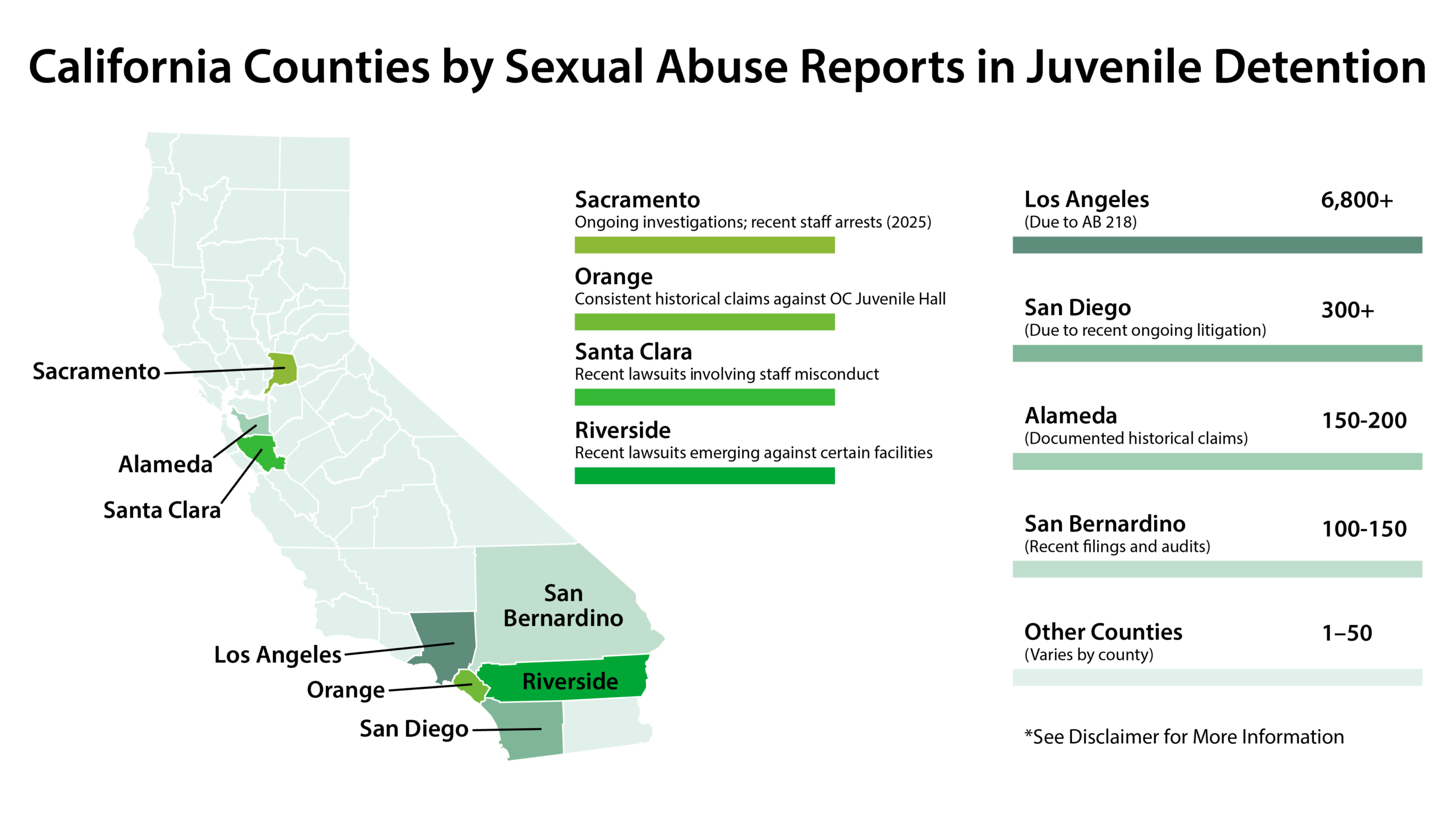
The following map shows some important information, but it's likely not what you think.
Notice that we say "Reports" in the title of the following map. This map doesn't show the prevalence of sexual abuse in juvenile detention centers in California counties, but instead how big an impact a well-publicized lawsuit can have.
Disclaimer*
Why Reporting Varies So Much From County to County
When you see thousands of reports clustered in certain California counties, like Los Angeles County, that doesn’t necessarily mean more abuse occurs there. In many cases, it just means that survivors finally felt safe enough to come forward.
But why? The answer is usually because there is safety in numbers and safety in the light of day when something is getting a lot of attention from the news and online.
Legislation like California's Assembly Bill 218 opens look-back windows that allow people to file lawsuits for abuse that happened years or even decades ago. Once large, coordinated lawsuits start gaining traction, survivors who have stayed silent all these years start to come forward because now they have something they didn’t before: safety in numbers and in the light.
Coming forward by yourself is terrifying. Coming forward alongside hundreds or thousands of others is different. It signals credibility, protection, and a real chance at accountability. Additionally, widespread coverage means that secret retaliation is unlikely.
So when you see large report totals tied to major lawsuits, you’re often looking at years of buried abuse surfacing all at once, not a sudden spike in new incidents. But why are numbers so low in other counties?
Why Reporting Numbers Stay Low in Other Counties
On the other side of the coin, counties that are shaded lightly above due to "low report counts" should never be read as proof that abuse isn’t happening.
More often, they reflect how difficult it is for detained youth to be believed or protected.
Common barriers include:
- Fear of retaliation from staff or other detainees
- Kids not being taken seriously when they report misconduct
- Adult authority figures being believed over youth by default
- Threats, intimidation, or disciplinary consequences for speaking up
- Internal investigations that go nowhere
- Shame, trauma, or fear of stigma
- Lack of outside oversight or media attention
Until a major lawsuit or investigation creates momentum, many survivors stay silent. Once that tipping point hits, reporting often rises quickly because youth realize they’re no longer standing alone.
Understanding Your Right to Seek Justice
Surviving sexual abuse is not just an injustice; it’s an experience that no one should endure, especially within a system meant to safeguard young people. California laws recognize your right to seek justice, even if the abuse happened years ago. You deserve to hold those responsible accountable for their actions and the harm they caused.
California laws recognize your right to seek justice, even if the abuse happened years ago. You deserve to hold those responsible accountable for their actions and the harm they caused.
Recent lawsuits have named numerous facilities across the state, shedding light on the systemic failures that allowed abuse to happen. These include locations like Barry J. Nidorf Juvenile Hall in Sylmar, Central Juvenile Hall in Eastlake, and many others. These cases embody the bravery of survivors stepping forward, proving that change is possible and that accountability matters.
California offers specific legal pathways for pursuing claims of childhood sexual abuse. Extended statutes of limitations allow survivors to file lawsuits well into adulthood, ensuring that no one is left without the opportunity for justice. By taking this step, you are reclaiming your voice and your power.
Why Filing a Juvenile Hall Lawsuit Matters
Filing a lawsuit isn't just about financial compensation. It's about acknowledgment, accountability, and paving the way for a safer future. Every survivor who steps forward helps to expose the truth and push for reform. Here's why taking legal action is so important:
Here’s why taking legal action is so important:
- Reclaiming Your Voice: Sharing your story can be a powerful act of healing. It ensures that your experience is recognized and validated.
- Holding Institutions Accountable: The facilities that failed in their duty must answer for their negligence. Lawsuits incentivize better practices and stricter oversight to protect others.
- Driving Systemic Change: When survivors unite to demand accountability, it forces institutions to implement reforms, ensuring safety and dignity for future generations.
Your courage to act today may inspire others to come forward tomorrow. Together, survivors are changing a broken system.
The Legal Process for Filing a Sexual Abuse Lawsuit Against a California Juvenile Detention Center
Our attorneys can guide you through every step of the legal process. Here’s what the process typically looks like:
- Confidential Consultation
Your first step is connecting with our compassionate legal team. During this free, private consultation, you can safely share your story and learn about your legal options. - Investigation
We take a deep look into your case, gathering evidence, speaking to witnesses, and working with experts to build a strong claim. - Filing the Lawsuit
Once the investigation is complete, we will file your claim. This legal action seeks justice and compensation for the harm you endured. - Negotiation or Trial
Many cases settle before going to court. However, if a fair resolution isn’t reached, our team is ready to take your case to trial.
From start to finish, you’ll have a dedicated advocate by your side, ensuring your voice is heard and your rights are protected.
Compensation Available to California Juvenile Detention Sexual Abuse Survivors
You can’t put a price on the pain you’ve endured, but the law does allow you to seek financial compensation for the harm caused by sexual abuse in a juvenile detention center. This money is not a reward. It’s a way to help you recover, rebuild, and access the support you need to move forward.
In a California juvenile detention center sexual abuse lawsuit, you may be entitled to compensation for:
- Medical Costs: This includes hospital bills, ongoing therapy, counseling, and other treatments needed to help you heal physically and emotionally.
- Pain and Suffering: Emotional trauma, anxiety, depression, and PTSD are very real consequences of abuse. You may be able to recover damages for these effects.
- Lost Wages or Earning Potential: If the abuse impacted your ability to work or pursue a career, you may be compensated for that loss.
- Punitive Damages: In cases where abuse was covered up or ignored, California law allows survivors to seek additional damages to punish the wrongdoers and prevent future harm.
This compensation can’t erase what happened, but it can give you the resources and support to take back control of your life.
What is the Average Juvenile Detention Center Settlement?
We draw our estimates from individual claims we have resolved, along with the average settlement value in Los Angeles County, which could be a bit misleading based on the sheer number of claims and allegations of fraud levied against Downtown L.A. Law Group (DTLA). However, the average settlement value per claim exceeded $550,000.
Previous California Juvenile Hall Lawsuit Payout
Last April, Los Angeles County reached a $4 billion settlement to resolve nearly 6,500 individual claims of institutional sexual abuse. This is the largest known sexual abuse lawsuit payout in history.
In early November, Los Angeles County approved an additional allocation of $828 million to resolve 414 individual claims of sexual abuse in juvenile halls. In other words, the average value of the second batch of claims resolved by Los Angeles County averages out to $2 million per case.
Previous National Juvenile Detention Lawsuit Settlements
In late 2023, the state of New Hampshire resolved an individual claim for $1.5 million and allocated an additional $100 million into a fund to cover ongoing sexual abuse claims against youth detention facilities.
In May 2024, a New Hampshire jury rendered a $38 million verdict to a sexual abuse survivor for acts that took place at a youth detention center (Sununu Youth Services Center). An additional 1,100 lawsuits have since been filed.
In 2021, Washington state paid out just over $800,000 to settle an individual claim that occurred at a youth camp.
In 2020, Lancaster County (Pennsylvania) resolved an individual detention abuse claim for $400,000.00. The survivor was sexually assaulted at Lancaster County Youth Intervention Center by a guard.
There are approximately 11,000 pending lawsuits in Maryland alleging decades of systemic sexual abuse in the state's juvenile detention centers.
We believe that qualifying claims will resolve north of $500,000.
| Settlement / Verdict | Case Summary |
|---|---|
| $550,000+ (average) | Average value per Los Angeles County juvenile detention claim |
| $4 Billion | ~6,500 Los Angeles County sexual abuse claims settled |
| $828 Million | 414 Los Angeles County claims, ~ $2M per case |
| $1.5 Million | New Hampshire individual detention abuse settlement |
| $100 Million Fund | New Hampshire survivor compensation fund |
| $38 Million | New Hampshire jury verdict |
| $800,000+ | Washington State youth camp abuse settlement |
| $400,000 | Lancaster County, Pennsylvania detention abuse settlement |
| $500,000+ | Our guess at what qualifying claims will settle for |
*These settlement figures are provided for informational purposes only and reflect past results used to form an educated estimate, not a guarantee of compensation in any future juvenile detention sexual abuse case.
How Long Do I Have to File a Sexual Abuse Civil Lawsuit in California?
Being abused in a juvenile detention center isn’t just a violation of your dignity. It’s against the law. California recognizes the rights of survivors to file civil lawsuits, even if the abuse happened years ago.
Because of changes in California law, you may now have the ability to take legal action, even if you were told you were too late before. Under current law, if you were abused as a child, you can file a lawsuit until the age of 40, or within five years of discovering the psychological injury caused by the abuse.
Even if the abuse happened decades ago, you may still have time. Thanks to a 2020 law, the state gave survivors of childhood sexual abuse a three-year window to file claims that would otherwise have been time-barred.
That window may have closed, but if your claim involves a cover-up or institutional failure, like those seen in California juvenile detention centers, you may still qualify under different rules.
State and Federal Laws Designed to Protect Juveniles in Custody from Abuse
There are strong laws in place meant to protect youth in detention, and when those laws are broken, survivors have every right to seek justice.
Federal Protection: The Prison Rape Elimination Act (PREA)
PREA is a federal law passed in 2003 to stop sexual abuse and harassment in correctional facilities, including juvenile centers. It requires:
- Clear policies to prevent and report abuse
- Confidential reporting systems for victims
- Strict staff training and screening
- Independent investigations of abuse claims
Unfortunately, many facilities have failed to follow these rules—and survivors are paying the price.
California State Laws
California has gone even further by passing laws that directly impact juvenile detention centers:
- CANRA (Child Abuse and Neglect Reporting Act): This law requires staff to report any suspected child abuse. Failure to report is a crime.
- Youth Bill of Rights (SB 823): Guarantees children in custody the right to be safe and free from abuse. It also affirms their right to health care, mental health services, and fair treatment.
- Oversight by the Office of the Inspector General: This independent agency monitors juvenile facilities and investigates complaints. It can recommend reforms and report facilities that violate the law.
When these safeguards are ignored, survivors have every right to pursue justice through a juvenile detention center sexual abuse lawsuit.
Discuss Your Case with a Trusted California Sexual Abuse Lawyer
If you are ready to seek justice for the harm you suffered at a California juvenile detention center, File Abuse Lawsuit is here. Our team of compassionate attorneys is dedicated to guiding you through the legal process while providing the support and respect you deserve.
Here’s how our attorneys can help you:
- Listen to your story with compassion and respect
- Explain your legal rights in simple, clear language
- File a lawsuit on your behalf with no upfront costs
- Stand by your side through the legal process
- Connect you with therapists, counselors, and other support services
You are not defined by what happened to you. You are strong. You have a voice. And you deserve justice.
Contact File Abuse Lawsuit today at (209) 283-2205 or through our online form for a free and confidential consultation.
Sexual Abuse at California Juvenile Detention Centers FAQs
Here are answers to some of the most common questions survivors ask when considering a California juvenile detention center sexual abuse lawsuit.
Can I file a lawsuit even if the abuse happened a long time ago?
Yes. In 2019, child sexual abuse lawsuits saw an extension of the statute of limitations. California passed the Child Victims Act of 2019. Thus, California law gives survivors until the age of 40, or five years after discovering the effects of the abuse, to file a lawsuit.
There are also exceptions for institutional cover-ups. In many cases, juvenile detention facilities deliberately hide, misclassify, or fail to recognize misconduct.
Contact us to learn if you qualify. Even if the abuse occurred many years ago, a sexual abuse lawsuit may still be compensable.
Will my identity be made public?
No. We take your privacy seriously. Your identity can be kept confidential, and court records can be sealed to protect you. You're in control of how much you share and when. We understand that most sexual abuse survivors are hesitant to come forward due to fear of being judged or potential repercussions. We take your privacy very seriously.
Do I have to go to court?
Not necessarily. Many cases settle without going to trial. If a fair settlement isn’t offered, we’re fully prepared to go to court, but the choice is always yours.
How long does the process take?
Every case is different. Some settle in a matter of months, while others may take longer, especially if they go to trial. We’ll keep you informed every step of the way.
How much does it cost to hire a lawyer?
Nothing upfront. We work on a contingency basis, which means we only get paid attorney’s fees if we win money for you. There’s no financial risk to you.